Whoa-a! Up 10.7% on the S&P in a week to 757. Now that's a bear market rally if I have ever seen one.
A leaked internal memo from Citi and some decent retail numbers (I'll take a look at the MW numbers from the interest list), given the expectations, all lead to a major money making opportunity.
The only problem is that the average person, and hedge fund for that matter, was probably on the side line in most cash given the fear of the last several months. It looks like an excellent example of even though things may go lower still, one needs to have some money invested, or risk being left out of the party altogether.
Stocks can get "too cheap". And when they do, we need to start investing a little bit, knowing that things could still go down, but that there will also be opportunities like last week. A lot of companies in consumer land, for example, were up 30+%!
I look forward to getting back at it, as well as hearing from you! Vacay is over.
-2outof4
Sunday, March 15, 2009


Anyone Know an Orthopedist?
I'm back! And in order to show you that I'm not only interested in "nerdy" things, I'll give you a glimpse of the more action packed side of "SB '09" (the moniker given to our little vacation by a fun loving gal from Dallas).
For anyone interested in mountain sports, I highly recommend heading out to the "I-70 Corridor" resorts and vistas in beautiful Colorado. Not only is the economy bringing down the prices of condo rentals and everything else, it means the slopes are uncrowded during the week.
Our first day out was a time to get our feet under ourselves and loosened up for more action later in the week, or so I thought. When my friend, DB, wanted to venture into the terrain park almost immediately, I thought he was crazy. However, I went along with him anyway, which explains past pictures of me wrapped around trees and in creek beds. You see, he is a budding Warren Miller, and is always after the action shot!
This video is of the first jump, the first time in the park at A-Basin:

 Nope, definitely not an ambi-turner, but the snow and scenery in Shangri-La at Vail were amazing:
 With so much snow, the flat run-outs often led to treks back to steeper terrain:
 But alas, not being able to turn right in the bums and deep stuff, due to a bum knee, left me one more day off, followed by a couple of sunny and relaxing days with Mrs./Nurse 2outof4 on the cruisers! Meanwhile, DB found another partner to ski the "Minturn Mile", an out of bounds run down to the village of Minturn, west of Vail, on our last day:
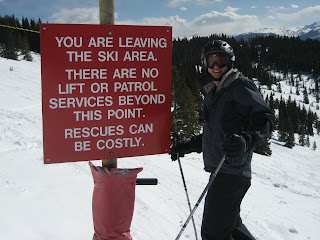 All in all, a great vacation, despite the obvious, with friends and family. And to paraphrase the great Warren Miller, go ahead and move to ski country. If you don't, you'll be one year older when you do.
For anyone interested in mountain sports, I highly recommend heading out to the "I-70 Corridor" resorts and vistas in beautiful Colorado. Not only is the economy bringing down the prices of condo rentals and everything else, it means the slopes are uncrowded during the week.
Our first day out was a time to get our feet under ourselves and loosened up for more action later in the week, or so I thought. When my friend, DB, wanted to venture into the terrain park almost immediately, I thought he was crazy. However, I went along with him anyway, which explains past pictures of me wrapped around trees and in creek beds. You see, he is a budding Warren Miller, and is always after the action shot!
This video is of the first jump, the first time in the park at A-Basin:
Prior to that, two kids with baggy pants and fluorescent bandannas skied up next to us. So, I couldn't look chicken! The video doesn't really do the ramp, height or distance justice. It was freakin scary!
Is it an optical illusion?:
They're so cute at this age:

DB gets all the right angles:
I should have known by the shaking in my legs from all the adrenaline that the next move was not a smart one. Always listen to your body! But with a combination of DB chiding me for more action shots and the size of the kicker being considerably smaller than the first, I went ahead:
Ouch! Big mistake. As you can see, I got rotated a little too far backward and just crumpled to the ground, bending my left knee unnaturally backward, while twisting severely and rolling over my equipment! Better go see ski patrol:

Nurse 2outof4 to the rescue! Ski patrol didn't really know anything except that there was no bone sticking out of my ski pants. So, it was off to the ER. The MRI machine is not run on Sundays in Frisco, CO, so the Doc just tugged and pulled my knee around. Final diagnosis: didn't think there was any serious ligament damage, but maybe something wrong with my meniscus, definitely a bad sprain, wear a hinged don-joy brace, and lots of R.I.C.E. The departure nurse said that I would not ski again, and then quickly restated to say not that week.
Probably the worst part of the injury besides not being myself on skis, was it came with a strangely coincidental stomach virus that kept me up all night heaving and emitting sounds that none of my housemates could identify as human! Needless to say, I was on my back on the couch on Monday.
But Tuesday we had 10 to 12 inches of fresh snow at Vail. Two legs be damned!
This is not a bad shot by DB, considering for all intents and purposes I am skiing on one leg and unable to turn to the right:
Nope, definitely not an ambi-turner, but the snow and scenery in Shangri-La at Vail were amazing:With so much snow, the flat run-outs often led to treks back to steeper terrain: But alas, not being able to turn right in the bums and deep stuff, due to a bum knee, left me one more day off, followed by a couple of sunny and relaxing days with Mrs./Nurse 2outof4 on the cruisers! Meanwhile, DB found another partner to ski the "Minturn Mile", an out of bounds run down to the village of Minturn, west of Vail, on our last day:All in all, a great vacation, despite the obvious, with friends and family. And to paraphrase the great Warren Miller, go ahead and move to ski country. If you don't, you'll be one year older when you do.-2outof4
Friday, March 6, 2009
Two Investment Insights
1) It is almost never good when a company comes out and says that it is going to make its earnings announcement earlier than originally scheduled. See Exhibit A, Gymboree Corporation (ticker: GYMB) http://finance.yahoo.com/q?s=gymb (click the five day chart).
The crazy thing is that the news of the pre-announcement came out on Wednesday morning before the opening bell. One had all day Wednesday to short the stock before the Company announced disaster after the bell that day.
2) In speaking with a housebuilding exec this week, the obvious question came up. If I could, where should I buy real estate today? He said that he only really likes central and northern Florida, specifically Orlando, Tampa and Jacksonville. Paraphrasing the exec, "at least that's the bet I'm making!"
-2outof4
The crazy thing is that the news of the pre-announcement came out on Wednesday morning before the opening bell. One had all day Wednesday to short the stock before the Company announced disaster after the bell that day.
2) In speaking with a housebuilding exec this week, the obvious question came up. If I could, where should I buy real estate today? He said that he only really likes central and northern Florida, specifically Orlando, Tampa and Jacksonville. Paraphrasing the exec, "at least that's the bet I'm making!"
-2outof4
2outof4 on Vacation
That's right. I am escaping the Internet for a whole week! Seriously, I hope to be on the web as little as possible, and will not be posting until I return.
Starting Saturday and concluding the following weekend, I hope to be making some additional videos and photos, so that you are not quite as bored when you come to the site.
Hopefully, we don't hit 550 on the S&P while I'm gone!
-2outof4
Starting Saturday and concluding the following weekend, I hope to be making some additional videos and photos, so that you are not quite as bored when you come to the site.
Hopefully, we don't hit 550 on the S&P while I'm gone!
-2outof4
Who Knew?
A while back I was frequently mocked by some former colleagues for participating in something they deemed "Yoga Pilates". Yoga Pilates was actually a class at Gold's Gym called BodyFlow - kind of a Yoga and meditation mix. Not only was the class a good stretch for my not-so-limber body, but I found myself very relaxed by the end of the class.
Well, here is another one. This time it can be done in the comfort and seclusion of your own home. I mocked it before I tried it. But I have found "08 Minute Pilates" to be an excellent source of core strengthening - something us desk jockeys can appreciate. Plus, Mrs. 2outof4 says that I am standing straighter. (I think its that she didn't like the beer gut.)
The video is led by Andrea Bernard and her henchwomen - Edna and Angie. Don't knock it before you try it!
-2outof4
Well, here is another one. This time it can be done in the comfort and seclusion of your own home. I mocked it before I tried it. But I have found "08 Minute Pilates" to be an excellent source of core strengthening - something us desk jockeys can appreciate. Plus, Mrs. 2outof4 says that I am standing straighter. (I think its that she didn't like the beer gut.)
The video is led by Andrea Bernard and her henchwomen - Edna and Angie. Don't knock it before you try it!
-2outof4
Thursday, March 5, 2009
State of Manufacturing in the US
I receive many great emails throughout the day with fantastic economic data and indicators. A friend in the northwest of the US sent me this from his own daily email flow:
"I was putting some data together from the BLS website. This is the number of manufacturing jobs in the US over time. They changed the way they presented the data in 2003 and I think moved some jobs that used to be called manufacturing to somewhere else. So there is a weird drop then. But still, the trend is amazing as the economy and population has grown a ton over this time. A lot of this is the big 3 auto companies, but still. Manufacturing used to employ like 7% of the US population and now it is 3% or something like that. It has gone from 14% of jobs to 8% of jobs. Anyway, I thought you would think this was interesting data. Easy to see why cities in the Midwest are hurting so badly. Population keeps leaving as the jobs leave. Or cities like Detroit just get destroyed with unemployment, crime, etc. Interesting to think what will happen. Will it go to zero? Will this reverse if we get rid of unions? This just cant be good for the US economy."

(You should just be able to click on the graph to see it more clearly.)
I'll take this post to also add a book to the book list. "Running Money: Hedge Fund Honchos, Monster Markets and my Hunt for the Big Score" by Andy Kessler (http://www.amazon.com/Running-Money-Honchos-Monster-Markets/dp/0060740655/ref=pd_bbs_3?ie=UTF8&s=books&qid=1236314094&sr=8-3) is a tale of Mr. Kessler's day to day challenges starting and running an investment firm, but also of his views on technology, product cycles, and the economy in general. It is easy to read and I recommend it.
In other words, some computer scientists in the States develop a microprocessor for which a Chinese computer manufacturer will pay $100 each (note these figures are just for illustrative purposes). There is no export from the US because the US company will license the technology. So for every $100 microprocessor the computer manufacturer pays the US company to license the US company earns 80%, or $80. The Chinese company integrates the microprocessor into the computer and exports the computer to the US for say $1,000 and earns a 5% margin, or $50.
In this transaction the American trade deficit is either $900 or $1,000 depending, I assume, on repatriation. However, the American company has earned 60% more on the transaction, and not only that but the American public is either directly or indirectly (through retirement plans) invested in the microprocessor company, so as it grows profits, Americans are in theory becoming more wealthy.
So does it make sense manufacturing jobs are being pushed offshore? Yes it does. Does it matter? It matters if Americans as a whole cannot innovate and grow businesses the way they have throughout America's brief history. Do I worry about the fact in itself that manufacturing jobs are decreasing? No, because I agree and have witnessed the above thought process in practice. It is also interesting to note the authors' numbers - 7% to 3%. Big percentage difference, relatively small on an absolute basis.
-2outof4
"I was putting some data together from the BLS website. This is the number of manufacturing jobs in the US over time. They changed the way they presented the data in 2003 and I think moved some jobs that used to be called manufacturing to somewhere else. So there is a weird drop then. But still, the trend is amazing as the economy and population has grown a ton over this time. A lot of this is the big 3 auto companies, but still. Manufacturing used to employ like 7% of the US population and now it is 3% or something like that. It has gone from 14% of jobs to 8% of jobs. Anyway, I thought you would think this was interesting data. Easy to see why cities in the Midwest are hurting so badly. Population keeps leaving as the jobs leave. Or cities like Detroit just get destroyed with unemployment, crime, etc. Interesting to think what will happen. Will it go to zero? Will this reverse if we get rid of unions? This just cant be good for the US economy."

(You should just be able to click on the graph to see it more clearly.)
I'll take this post to also add a book to the book list. "Running Money: Hedge Fund Honchos, Monster Markets and my Hunt for the Big Score" by Andy Kessler (http://www.amazon.com/Running-Money-Honchos-Monster-Markets/dp/0060740655/ref=pd_bbs_3?ie=UTF8&s=books&qid=1236314094&sr=8-3) is a tale of Mr. Kessler's day to day challenges starting and running an investment firm, but also of his views on technology, product cycles, and the economy in general. It is easy to read and I recommend it.
The reason I bring this book up in reference to the above email and clear deterioration in manufacturing jobs in the US, is because Mr. Kessler spends time outling his thoughts on where those jobs have gone. I believe his answer would be somewhere along the lines of who cares?
He essentially believes that the US has outsourced a lot of the low margin heavy lifting, i.e. manufacturing. However, the US makes up for that by earning higher margins on the "intellectual property" (IP) that goes into the products that then come back into the US. The US consumer benefits due to increased efficiency and product income, as well as income redistribution through the stock market to things like retirement savings, etc.In other words, some computer scientists in the States develop a microprocessor for which a Chinese computer manufacturer will pay $100 each (note these figures are just for illustrative purposes). There is no export from the US because the US company will license the technology. So for every $100 microprocessor the computer manufacturer pays the US company to license the US company earns 80%, or $80. The Chinese company integrates the microprocessor into the computer and exports the computer to the US for say $1,000 and earns a 5% margin, or $50.
In this transaction the American trade deficit is either $900 or $1,000 depending, I assume, on repatriation. However, the American company has earned 60% more on the transaction, and not only that but the American public is either directly or indirectly (through retirement plans) invested in the microprocessor company, so as it grows profits, Americans are in theory becoming more wealthy.
So does it make sense manufacturing jobs are being pushed offshore? Yes it does. Does it matter? It matters if Americans as a whole cannot innovate and grow businesses the way they have throughout America's brief history. Do I worry about the fact in itself that manufacturing jobs are decreasing? No, because I agree and have witnessed the above thought process in practice. It is also interesting to note the authors' numbers - 7% to 3%. Big percentage difference, relatively small on an absolute basis.
-2outof4
Different Angle on Higher Education Concerns
This article from the Consumer Digest takes another angle on the post from February entitled "Why Does College Cost So Much?":
http://news.prnewswire.com/DisplayReleaseContent.aspx?ACCT=104&STORY=/www/story/03-03-2009/0004981738&EDATE
They seem like very reasonable points, and just further reasons why the federal government should not allow these companies to bilk it for 20% net income margins.
-2outof4
http://news.prnewswire.com/DisplayReleaseContent.aspx?ACCT=104&STORY=/www/story/03-03-2009/0004981738&EDATE
They seem like very reasonable points, and just further reasons why the federal government should not allow these companies to bilk it for 20% net income margins.
-2outof4
Fair Tax - Do You Think It is Fair?
Hello! I have had some great suggestions and questions from a number of you. Today someone asked me about the "FairTax". I have to admit I knew very few of the details, but it sounds interesting.
http://en.wikipedia.org/wiki/FairTax
Essentially the FairTax abolishes Federal income tax and payroll tax. The only Federal tax that we are left with is a sales tax, proposed to be 23%. There seem to be lots of pros and cons.
Included in the pros are that this tax captures the entire US tax base from less wealthy to mega wealthy and from illegals to under reporters. There are vast numbers of anecdotes suggesting that a high percentage of able US workers either do not pay at all or under pay their taxes.
Opposition includes, similar to the Flat Tax, that the FairTax is a "regressive" tax because it taxes the lower and middle class at a greater percentage of their income than the wealthy. It is also said that the FairTax would not capture as much revenue as the current system.
The last point I think is reasonable. This suggests that Federal tax revenue in 2007 amounted to $2.6 trillion:
http://www.heritage.org/Research/features/budgetchartbook/fed-rev-spend-2008-boc-C1-Federal-Spending-Is-Growing.html
This suggests that consumption (granted, do not know the exact parameters of this definition) is about 60-65% of GDP:
http://www.bloggingstocks.com/2009/02/04/will-the-u-s-economys-focus-shift-from-consumption-to-producti/
This suggests that 2008 GDP amounted to $14.3 trillion:
http://en.wikipedia.org/wiki/List_of_countries_by_GDP_(nominal)
Therefore, if the US government taxed consumption (65% of GDP) at a 23% tax level, the revenue raised would equal $2.1 trillion, or half a trillion shy of 2007 levels.
It is true too that the FairTax seems to only tax end consumption and only "new" goods, so I presume it is not fair to include the full 65% of GDP. Nonetheless, it makes sense to me to look at plans like this. For one, it is glaringly more simple than the current tax code and the implementation difficulties that I could foresee are easily overcome. Don't forget, the current IRS budget is for approximately $11 billion annually. If a piece of that was offered to some private enterprise, I am sure it could come up with a way to solve the implementation glitches.
I understand that people will come down on the FairTax as regressive. But how can one argue that illegal immigrants and Joe the Plumber, who have either not reported taxes or significantly under reported taxes, should pay less that Joe the Garbage Collector or Jane the Software Engineer, who have dutifully paid tax through payroll their whole lives? Similarly, I do not really buy the argument that because wealthy people make more money, a greater percentage of it should be taxed. Plus, the FairTax is progressive in terms of consumption. The sales tax on a new Porsche is going to be a lot higher than a new Hyundai.
This does bring me to a a few questions. Does the FairTax stymie new product development? Isn't one incented to buy slightly used and use for longer? Whereas, that is arguably better for the planet in the long-run, it certainly would lower the government's income?
There seem to be many interesting angles and questions with regards to the FairTax, and I am curious to hear some other view points! Just because I did not get the math to work on my quick calculation, does not mean the tax is not a decent idea. After all, one can balance a budget through both the revenue and expense line items.
-2outof4
http://en.wikipedia.org/wiki/FairTax
Essentially the FairTax abolishes Federal income tax and payroll tax. The only Federal tax that we are left with is a sales tax, proposed to be 23%. There seem to be lots of pros and cons.
Included in the pros are that this tax captures the entire US tax base from less wealthy to mega wealthy and from illegals to under reporters. There are vast numbers of anecdotes suggesting that a high percentage of able US workers either do not pay at all or under pay their taxes.
Opposition includes, similar to the Flat Tax, that the FairTax is a "regressive" tax because it taxes the lower and middle class at a greater percentage of their income than the wealthy. It is also said that the FairTax would not capture as much revenue as the current system.
The last point I think is reasonable. This suggests that Federal tax revenue in 2007 amounted to $2.6 trillion:
http://www.heritage.org/Research/features/budgetchartbook/fed-rev-spend-2008-boc-C1-Federal-Spending-Is-Growing.html
This suggests that consumption (granted, do not know the exact parameters of this definition) is about 60-65% of GDP:
http://www.bloggingstocks.com/2009/02/04/will-the-u-s-economys-focus-shift-from-consumption-to-producti/
This suggests that 2008 GDP amounted to $14.3 trillion:
http://en.wikipedia.org/wiki/List_of_countries_by_GDP_(nominal)
Therefore, if the US government taxed consumption (65% of GDP) at a 23% tax level, the revenue raised would equal $2.1 trillion, or half a trillion shy of 2007 levels.
It is true too that the FairTax seems to only tax end consumption and only "new" goods, so I presume it is not fair to include the full 65% of GDP. Nonetheless, it makes sense to me to look at plans like this. For one, it is glaringly more simple than the current tax code and the implementation difficulties that I could foresee are easily overcome. Don't forget, the current IRS budget is for approximately $11 billion annually. If a piece of that was offered to some private enterprise, I am sure it could come up with a way to solve the implementation glitches.
I understand that people will come down on the FairTax as regressive. But how can one argue that illegal immigrants and Joe the Plumber, who have either not reported taxes or significantly under reported taxes, should pay less that Joe the Garbage Collector or Jane the Software Engineer, who have dutifully paid tax through payroll their whole lives? Similarly, I do not really buy the argument that because wealthy people make more money, a greater percentage of it should be taxed. Plus, the FairTax is progressive in terms of consumption. The sales tax on a new Porsche is going to be a lot higher than a new Hyundai.
This does bring me to a a few questions. Does the FairTax stymie new product development? Isn't one incented to buy slightly used and use for longer? Whereas, that is arguably better for the planet in the long-run, it certainly would lower the government's income?
There seem to be many interesting angles and questions with regards to the FairTax, and I am curious to hear some other view points! Just because I did not get the math to work on my quick calculation, does not mean the tax is not a decent idea. After all, one can balance a budget through both the revenue and expense line items.
-2outof4
Tuesday, March 3, 2009
S&P Shocker
Several people have asked me for a view on where the S&P trades to this year. Well, sitting at just about 700 currently, I have no idea where we will end the year. However, I would not be surprised at all if we saw 550 at some point this year. That's 21% lower than where we are today.
That possibility presents a major challenge for professional money mangers. Their overriding fear is missing the "bounce" to a level of 900 or greater. The bounce may well happen as a result of further government stimulus, or some other unforeseen boost to the economy, or for no good reason at all. So money managers risk not being invested at the time of this bounce. The problem for the pros is that the move to 550 may come first!
The above situation is the cause of much of the deer-in-headlight expressions seen up and down Wall Street. So, in terms of stock investing, my fundamental view is that company earnings will in general get worse, but you will be able to find companies that are out performing or whose stock has just been bid so low that it rallies with any kind of slightly positive company-specific data point (see February's UEIC post). So, in sum, this market favor's the cliched "stockpicker".
This viewpoint begs the question, why are there not more actively managed (defined by me as a product where the manager is attempting to make positive returns in all kinds of market conditions, and has the leeway to do so) products available out there for the average investor to include in his or her portfolio? Where is the hedge fund for the common person?
-2outof4
That possibility presents a major challenge for professional money mangers. Their overriding fear is missing the "bounce" to a level of 900 or greater. The bounce may well happen as a result of further government stimulus, or some other unforeseen boost to the economy, or for no good reason at all. So money managers risk not being invested at the time of this bounce. The problem for the pros is that the move to 550 may come first!
The above situation is the cause of much of the deer-in-headlight expressions seen up and down Wall Street. So, in terms of stock investing, my fundamental view is that company earnings will in general get worse, but you will be able to find companies that are out performing or whose stock has just been bid so low that it rallies with any kind of slightly positive company-specific data point (see February's UEIC post). So, in sum, this market favor's the cliched "stockpicker".
This viewpoint begs the question, why are there not more actively managed (defined by me as a product where the manager is attempting to make positive returns in all kinds of market conditions, and has the leeway to do so) products available out there for the average investor to include in his or her portfolio? Where is the hedge fund for the common person?
-2outof4
Feel Good
It should be pretty clear that the current state of the Union has me a bit down. But similar to a jammed rest stop on I-95 brightening my day, a good Aria doesn't hurt either.
This is Paul Potts singing a number, which I was fortunate enough to see live last week, on Britain's equivalent of Idol. Enjoy!
http://www.youtube.com/watch?v=1k08yxu57NA
-2outof4
This is Paul Potts singing a number, which I was fortunate enough to see live last week, on Britain's equivalent of Idol. Enjoy!
http://www.youtube.com/watch?v=1k08yxu57NA
-2outof4
Subscribe to:
Posts (Atom)


 Posts
Posts

